The recent in-orbit test campaign of the BOOSTER demonstrates that Liftero’s propulsion is fully operational in space. The campaign has produced measurable orbital changes following controlled thruster firings, with onboard telemetry confirming nominal system performance.
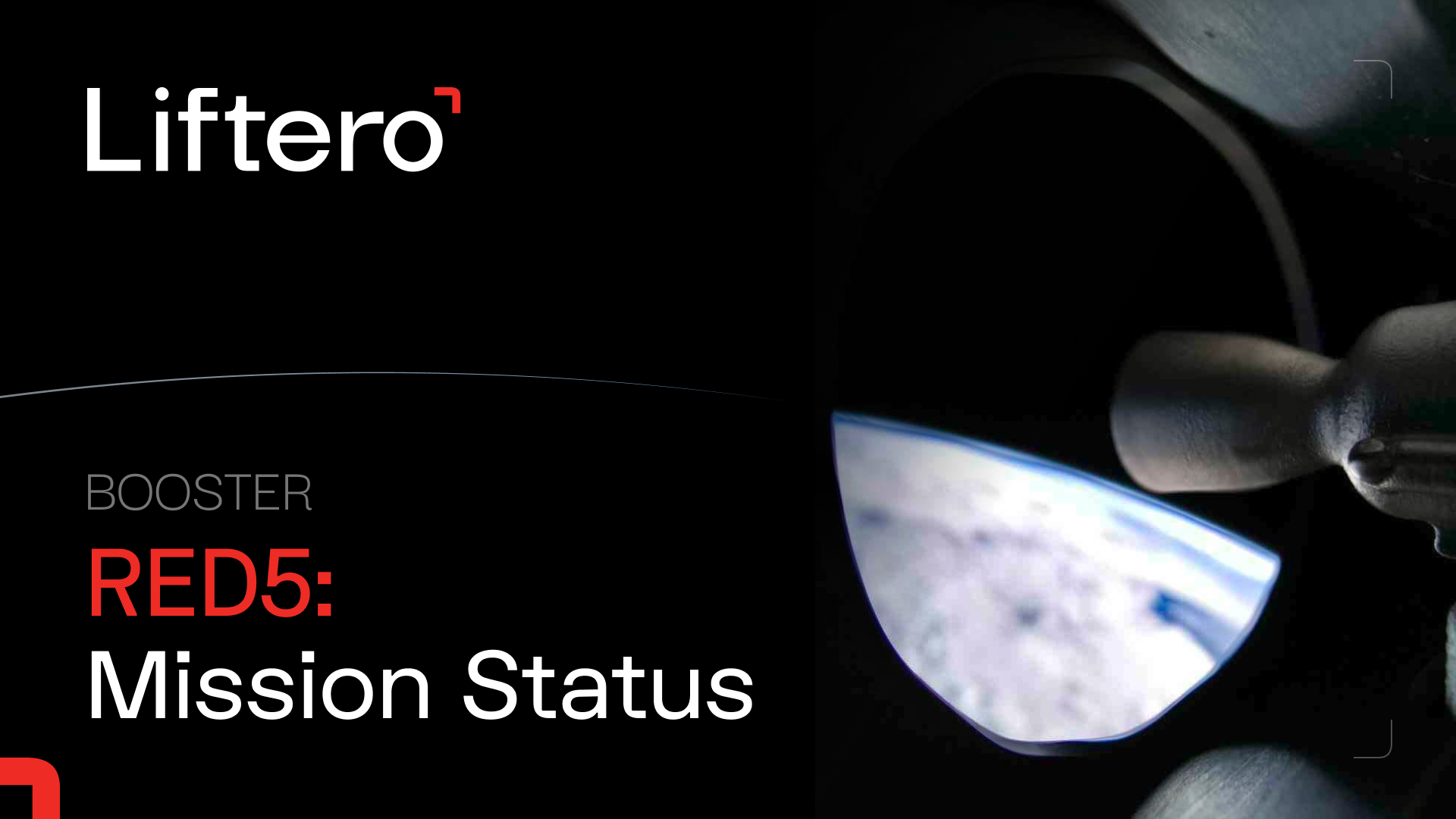
Liftero’s propulsion system, integrated aboard a 6U satellite platform operated by OrbAstro, began its active test campaign in February 2026. In the first weeks of testing, BOOSTER has already completed more than 50 thruster operations, delivered more than 4 m/s of delta-v, and generated over 40 Ns of total impulse.
From Lab to Orbit in 15 Months
Liftero developed the BOOSTER green chemical propulsion system from scratch to flight in roughly 15 months. The system is a turnkey propulsion solution that can be configured with total impulse ranging from 5 to more than 250 kNs and up to 14 thrusters of different thrust classes (1N, 5N and 20N). The company now offers BOOSTER commercially, primarily for satellites in the 30–500 kg mass range. Recently, Liftero announced a contract for two systems for an Indian in-orbit servicing customer.
RED5 is a technology demonstration mission designed to validate the BOOSTER system in orbit. The propulsion payload was integrated into a CubeSat satellite platform provided by OrbAstro. To fit within the satellite’s limited volume, BOOSTER was configured with a single 1N thruster, while still representing a complete propulsion system including propellant tanks, ECU and health monitoring.
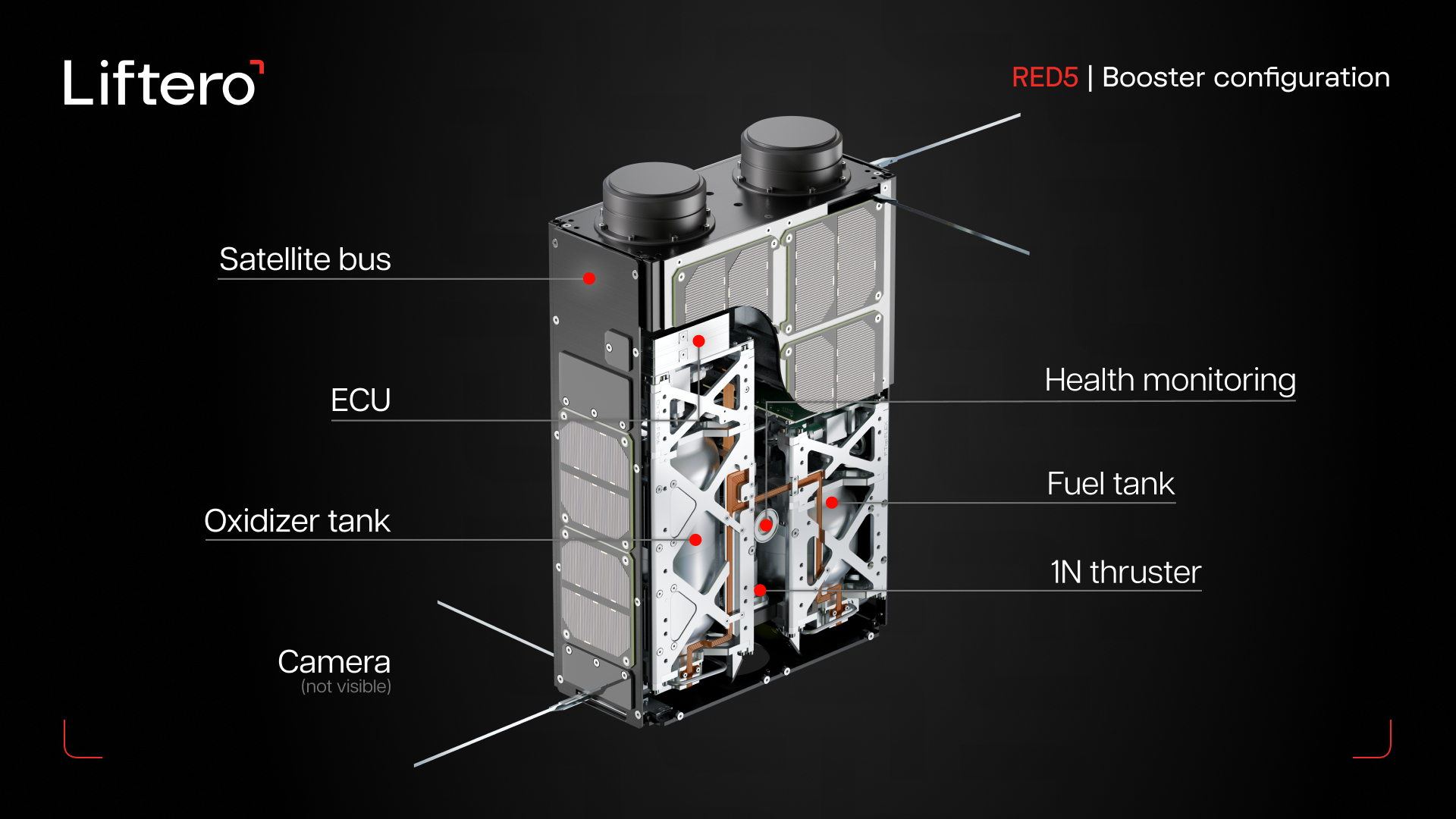
RED5 launched aboard SpaceX’s Transporter-13 rideshare mission in March 2025. The mission is operated by OrbAstro, which quickly established first contact and began satellite commissioning. Initial BOOSTER telemetry was received within the first few days, confirming that the payload survived launch and entered orbit in good health.
Initial In-Orbit Validation of BOOSTER
The commissioning phase included ground segment updates and readiness activities to support propulsion operations. Throughout 2025, regular health checks confirmed that the BOOSTER payload remained in excellent condition in orbit.
In late 2025, an initial series of propulsion operations and thruster firings was performed, allowing the Liftero team to preliminarily confirm nominal operation of all BOOSTER subsystems.
We’ve confirmed that BOOSTER operates nominally in orbit, and the data we’re seeing aligns with our ground qualification. This gives us strong confidence in the system’s performance as we continue the test campaign,” said Tomasz Palacz, Liftero CEO.
OrbAstro added: “We are pleased to see the satellite is supporting regular payload operations and delivering valuable in-orbit data.
The time in orbit provided valuable insights. The system remained in orbit for more than a year, exposed to vacuum, repeated thermal cycling every orbit, and radiation including multiple solar storms — without registering any anomalies. No issues were detected either in the ECU or in terms of propellant leakage. When propulsion operations began, the thruster responded nominally after the extended dormant period.
Ongoing Test Campaign
In February 2026, Liftero began its BOOSTER test campaign, which has already demonstrated measurable orbital maneuvers and repeated thruster firings. The campaign remains ongoing and continues to expand the dataset on BOOSTER’s in-orbit performance.
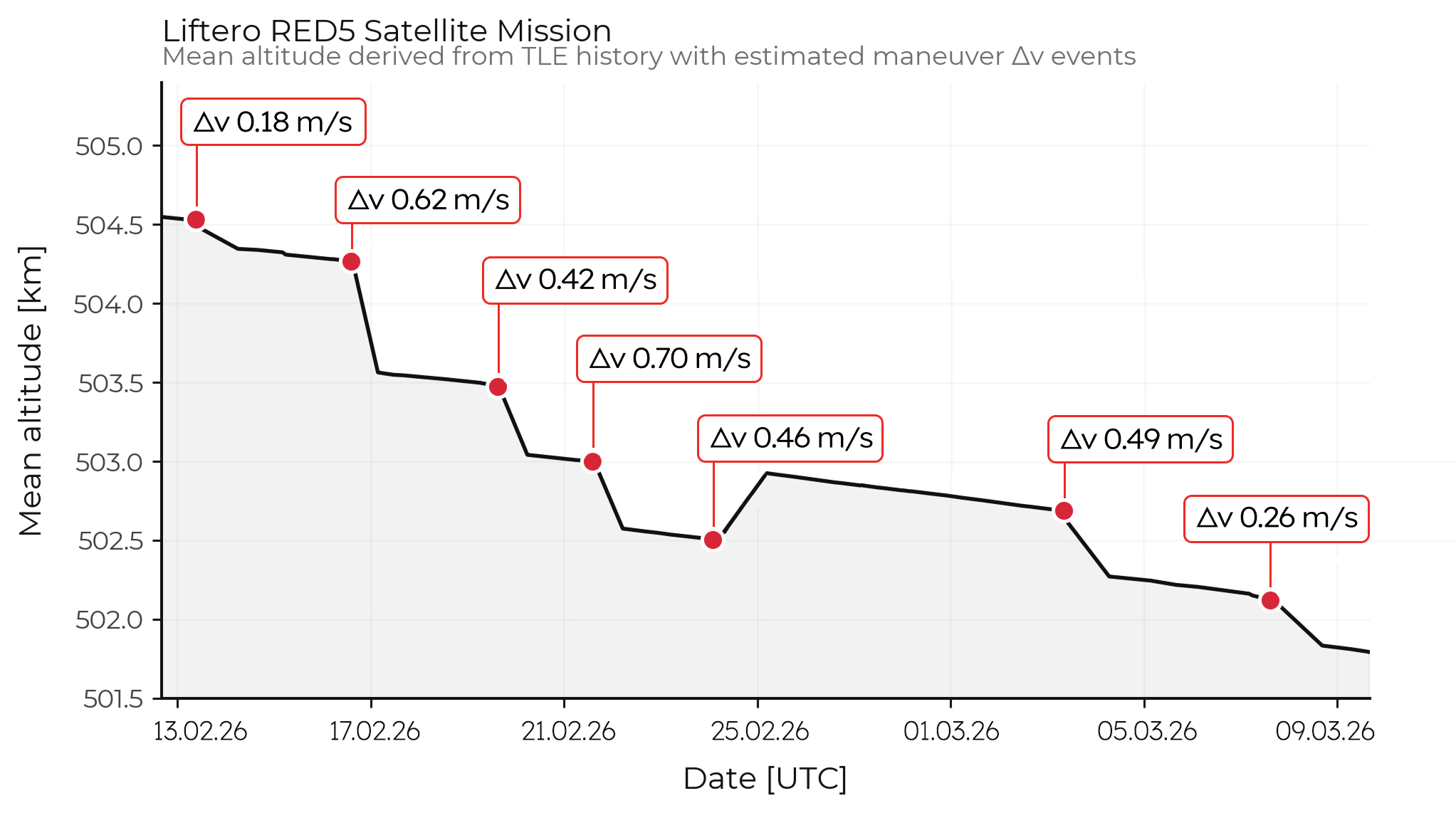
The results of these maneuvers are publicly observable through changes in TLE data, which reflect the cumulative effect of propulsion activity on the satellite’s orbit.
So far, thruster firings have been conducted with random satellite pointing, as the primary objective at this stage is to characterize propulsion performance across multiple operating conditions. Firings are executed in sequence, producing varying Δv between events — an effect visible in the satellite’s orbital altitude history.
“We’ve confirmed the most critical part: that BOOSTER operates nominally in space. Data from multiple sensors onboard strongly suggest that the system performs as qualified on the ground, which increases our confidence in the product and its performance, including thrust, impulse bits, specific impulse and thermal behavior. The tests continue, but we are already looking ahead, with planned deliveries in 2026 and growing demand across multiple satellite applications” – Tomasz Palacz, Liftero CEO
Liftero plans to continue the test campaign throughout 2026 to generate more statistical data, which will help reduce uncertainty in thrust and specific impulse estimates. The remaining mission goal is to perform more than 1,000 thruster cycles under different operating conditions and observe any potential anomalies or degradation. Additionally, Liftero, in coordination with OrbAstro, aims to demonstrate coordinated manoeuvres such as orbit raising, inclination changes, and an active de-orbit.
What’s Next for Liftero
The RED5 mission, while still ongoing, has achieved its primary goal of building flight heritage for the BOOSTER propulsion system, which Liftero now offers commercially. The mission, therefore, represents a key step toward bringing the system into operational satellite missions.
“With this major milestone behind us, our focus is now on bringing our product to the market by expanding our sales efforts and production capabilities. We see growing demand that represents a significant opportunity for Liftero. It’s always very challenging for new space hardware suppliers to enter the market, but we are confident in our strategy for the next 18 months, as it has already proven effective through our recent contract and several advanced discussions” – Przemysław Drożdż, Liftero COO
Liftero’s mission is to build propulsion systems that scale for the thousands of spacecraft that will operate in orbit. BOOSTER is the company’s first commercial product — a chemical propulsion system reengineered for the future scale of the space economy. By standardizing components, reducing complexity and eliminating problematic processes, Liftero can deliver mission-specific BOOSTER configurations within 6-9 months without custom engineering and at a cost competitive with most electric propulsion systems.